Valerie has been going to her first dance classes this fall. Here’s a look at what she’s learned —
Category: Russia
Posts relating to Russia.
Surprise: A Russian Dashcam Video
Some of you have probably seen videos of crazy driving in Russia. A lot of people here have dashcams, for various reasons. Here is perhaps the most surprising (watch from 1:25):
Trimming the Tree
It’s that time of year!
Valerie has an ‘ouchy’ where a bully pushed her down in the park. She’s recovering nicely!
To The Court!
Good news on the adoption: tomorrow Olga will take all of our documents and make our initial petition to the court.
Our local Family Services officers, who have been helping us prepare the packet (which took a few months to complete), said that our documents are perfect. So, we’re hopeful that a court date will be set soon.
There will be two court appearances before the decision is made. We’re VERY happy to be taking this next step.
A Remarkable Sight
This was impossible just 25 years ago. Christian worship, outdoors in the heart of St. Petersburg, Russia.
The location: Revolution Square, named for the Communist (Atheist) revolution.
Teacher’s Day in Russia
Another good article by pastor Andrei Furmanov —
Ever since the importance of teachers has been recognized by UNESCO, World Teacher’s Day is celebrated across the world on October 5. This includes celebrations to honor the teachers in a particular field or community in general. In most cases the way and reason of celebration vary amongst countries. Different countries celebrate the day on different dates attaching their own values to it.
In Russia, Teachers’ Day was celebrated on the first Sunday of October, between 1965 and 1994. And since 1994, the day is observed on October 5th, coinciding with World Teacher’s Day. More than one million high school teachers and 350,000 university teachers throughout Russia are honored on that October day. According to tradition, on Teacher’s Day Russia names the winner of the Teacher of the Year competition, who is usually awarded with the Crystal Pelican, the symbol of self-dedication.
TEACHER’S DAY ACTIVITIES IN RUSSIA
Celebration of Teachers day to honor the teachers for their immense role towards the society comprises lots of activities that add a fun note to the celebration. Some activities include dance, drama, games, competitions; thanks giving etc are organized by the students to make the occasion a grand affair for their teachers. They also perform mimicry of their mentors, instructors and tutors that involves a lot of excitement. This provides an opportunity for the students to show their respect and love to their teachers. The celebration is enjoyed by both students and those in whose honor it’s done with great zeal and enthusiasm. Some schools also reward the teachers for their priceless efforts towards the student’s betterment.
TEACHER’S SITUATION IN RUSSIA
While extending our congratulations to all teachers on this occasion, we would also like to use this opportunity to remind our readers of some of the problems facing those who have dedicated their lives to the art of teaching in Russia.
In his formal annual letter to teachers, Russia’s Education Minister usually points out the importance of the profession of a teacher and expresses gratitude to teachers for their devotion to their work and kindness. At the same time it was announced by the Ministry of Education and Science not so long ago that the number of teachers could possibly be reduced. It was emphasized that the ministry can only recommend that schools do so but cannot say how many teachers should be laid off or when. “In determining the optimal number of teachers, we can look not only at Russian experience but also international practice,” he explained. “In Europe on average there is one teacher per 13-15 students. Today there is one teacher per 9-10 pupils. Russia there are approximately 13 million pupils in Russia, and unfortunately due to demographic problems this number will not increase significantly in the near future. Growth won’t be seen earlier than 2015-2016. In order to be at the level we were at a decade ago, we need 1 million teachers. But right now we have 1.2 million, so there is potential for the reduction of 200,000.”
Statistics tell us that Russia spends a miserly 3.5% of its GDP on education, while the average in European countries is around 7-8%, in the US – 11%, in Finland – 16%, and in South Korea an incredible 23% of that country’s GDP.
Public school teachers along with public medical doctors are the two most underpaid and underappreciated professions in our country. Most public schools are terribly underfunded depending on free donations from parents, who are often forcefully encouraged to give towards school needs. It must sound strange for people from outside of Russia but this is the reality of our life.
The academic year has just begun and parent-teacher meetings are in full swing. Traditional topic of such meetings has always been the collection of money to meet school needs. However, this year parents are also worriedly discussing impending educational reforms, which nobody can seem to understand.
TEACHING THE TRUTH IN RUSSIAN CONTEXT
We cannot avoid anything that happens in this country, yet, we are committed to be mentors and instructors of our own kids both academically and spiritually. We continue investigating homeschooling possibilities in Russia context to be more effective in raising the new generation of believers on godly principles. We are devoted to teaching the truth not only to our children but to our congregation and people who have not seen the Truth yet. What joy! What privilege! What an honor!
Burned
After reporting on my great trip to the far north, I’ll turn to one thing that I saw along the way.
As we left Murmansk and headed west, we came upon an area that had apparently recently been burned by a very large forest fire:

By way of contrast, here is a view of the land not too far from there:

Having recently been in Montenegro where there are forest fires in the summertime, this burned area was a familiar sight to me. I asked Yura when the forest fire had happened.
His reply astonished me. He said, “It has been burned, but not by fire.”
It took me a little while to grasp his meaning as he told me more. Pollutants from local mines and smelters cause acid rain to fall on the area, burning the land and killing the plants. It appeared to me that thousands of acres have been affected. Here some other views:


And here is a video I made as we drove along —
http://www.youtube.com/watch?v=PUOPJqakmvc
Russia took control of this area in 1944, and all of this damage has been done since then. It will surely take decades to recover once the acid rain ends. I’ve heard that they’ve been installing scrubbers in the factories, so hopefully things are beginning to get better.
I’ll close by saying that even though the land appears burnt and forlorn, the hearts of the people I met there are full of light and love. We had great fellowship there, and I look forward to my next visit.
Dacha!
Pastor Andrei Furmanov wrote this great article about Russian Dachas —
In the days when the USSR was still a country collective farms, which were the backbone of Russian agriculture, were unable to produce enough, and the money for importing food was sufficient to only buy grain. The result was an official policy was that citizens of then USSR were supposed to grow a lot themselves.
Dachas were formed as cooperatives supervised by trade unions and the by-laws of these cooperatives were strict enough. First of all, the land technically of course did not belong to the members of those cooperatives, all land was state federal property at those times. It was leased to trade unions and could not be sold. Another serious restriction was that the usage of this land had to be limited to growing things.
One simply could not make a lawn on his or her land and enjoy the grass. That would be illegal and immediately would result in kicking the person out from the dacha cooperative and replacing him with a more devoted “weekend farmer”. Not more than one dacha per family was allowed.
The typical size of land given by the state to a family varied from 4 to 12 “sotok”, 6 and 8 being the most common (not surprising, now a popular newspaper for dacha owners is titled “6 Sotok” and everyone perfectly understands what they mean by that). One “sotka” = 100 square meters, so typical dacha land area of 6 sotok is equal to 0.16 acres.
Statistic says that now more than 30% of Russian families have dachas. And traditionally most of the dachas were distributed by the trade union organizations at the major industrial enterprises. Therefore in many cities the figures are even higher. Majority of dacha owners were workers, according to the party policy.
We are not saying that other social groups were not allowed to have dachas. It’s just important to realize that having a dacha was not a sign of belonging to elite class, and almost every family could easily get it if at least one family member had been working for 5 or 10 years at the same factory or plant.
But we have given you enough dry facts… Let us add some emotions to that long technical introduction to the concept of dacha – one of the key concepts of Russian life in both Soviet and post-Soviet times. Continue reading
Into the North

- North of the Arctic Circle, near Murmansk
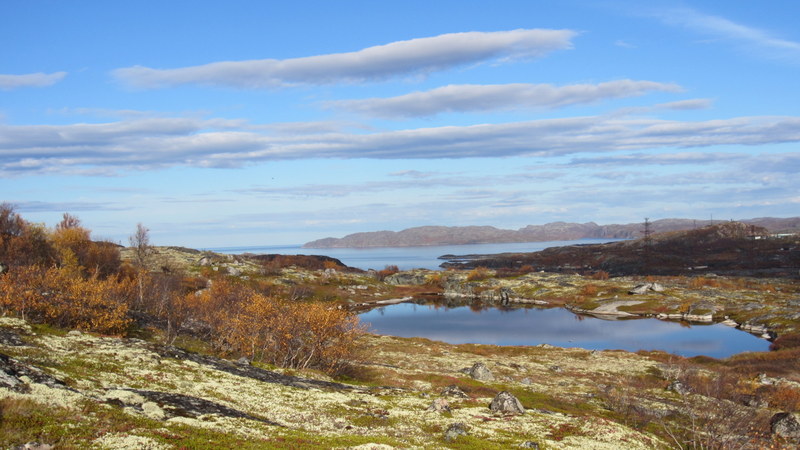
I’ve just returned from visiting Stoneworks missionary Yura Belonozhkin and see the work he’s doing up north. I met some wonderful people and saw an amazing part of the world.
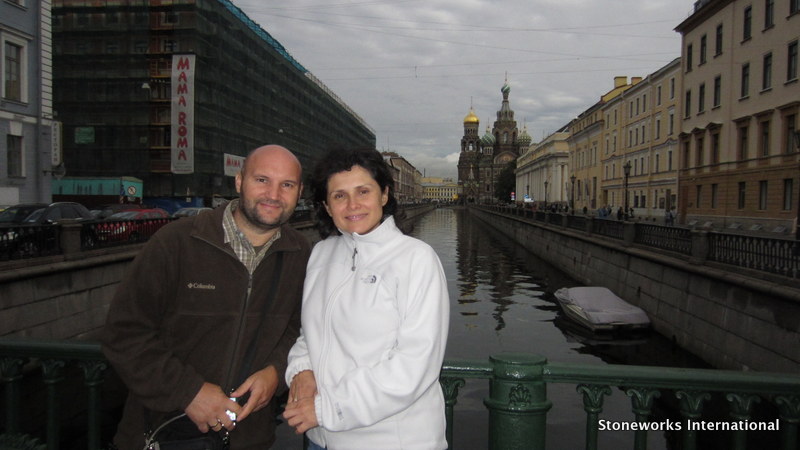 Vladimir and Mariana Cizmanski were visiting from Montenegro. I met them in Estonia and introduced them to our friends and ministry partners there. It is always gratifying when our Stoneworks partners to meet one another. My wife Olga and I had a good time showing them St. Pete.
While Marijana stayed in St. Petersburg with Olga, Vladimir and I headed north. The first day, we drove 1300 km (800 miles) to Zelenoborskiy, where Yura met us at a Christian drug rehab center.
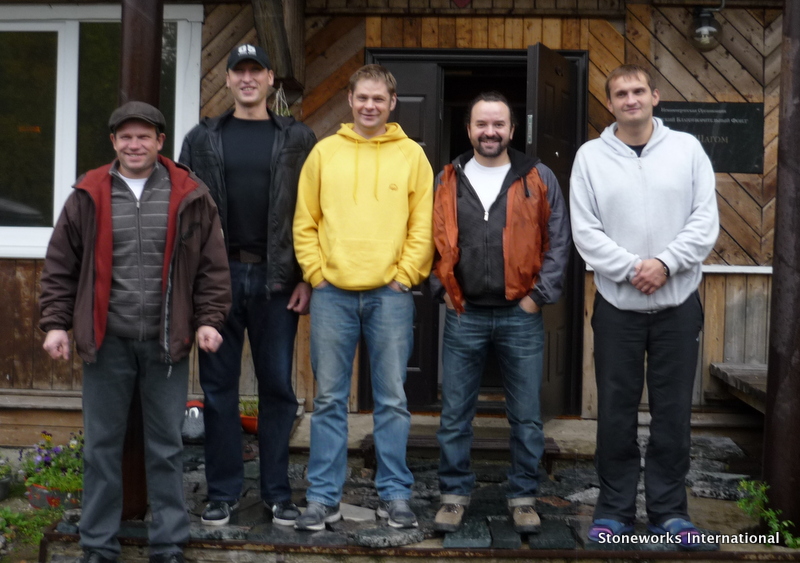 Yura and I spoke at a men’s meeting at the rehab center. It’s a great group of people, and several local churches support the center. Yura has led men’s meetings there and has very good relationships with the leadership. Over the next few days, as we visited other churches, we continued to meet men and women who are either in the rehab center or lived there before.
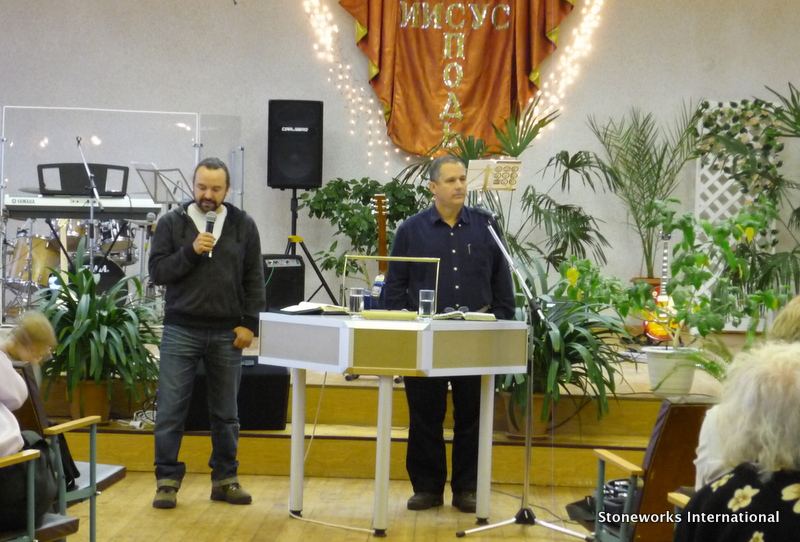
On the second day, we drove north to Olenegorsk to attend a prayer conference. Several local churches participated. I was asked to speak at the afternoon session, and I did a teaching on intercessory prayer. Peter Makarchuk is the bishop of several churches in that area, and he made us feel very welcome. He and Yura have a good relationship.

- Speaking at a prayer conference in Olenegorsk, Russia.
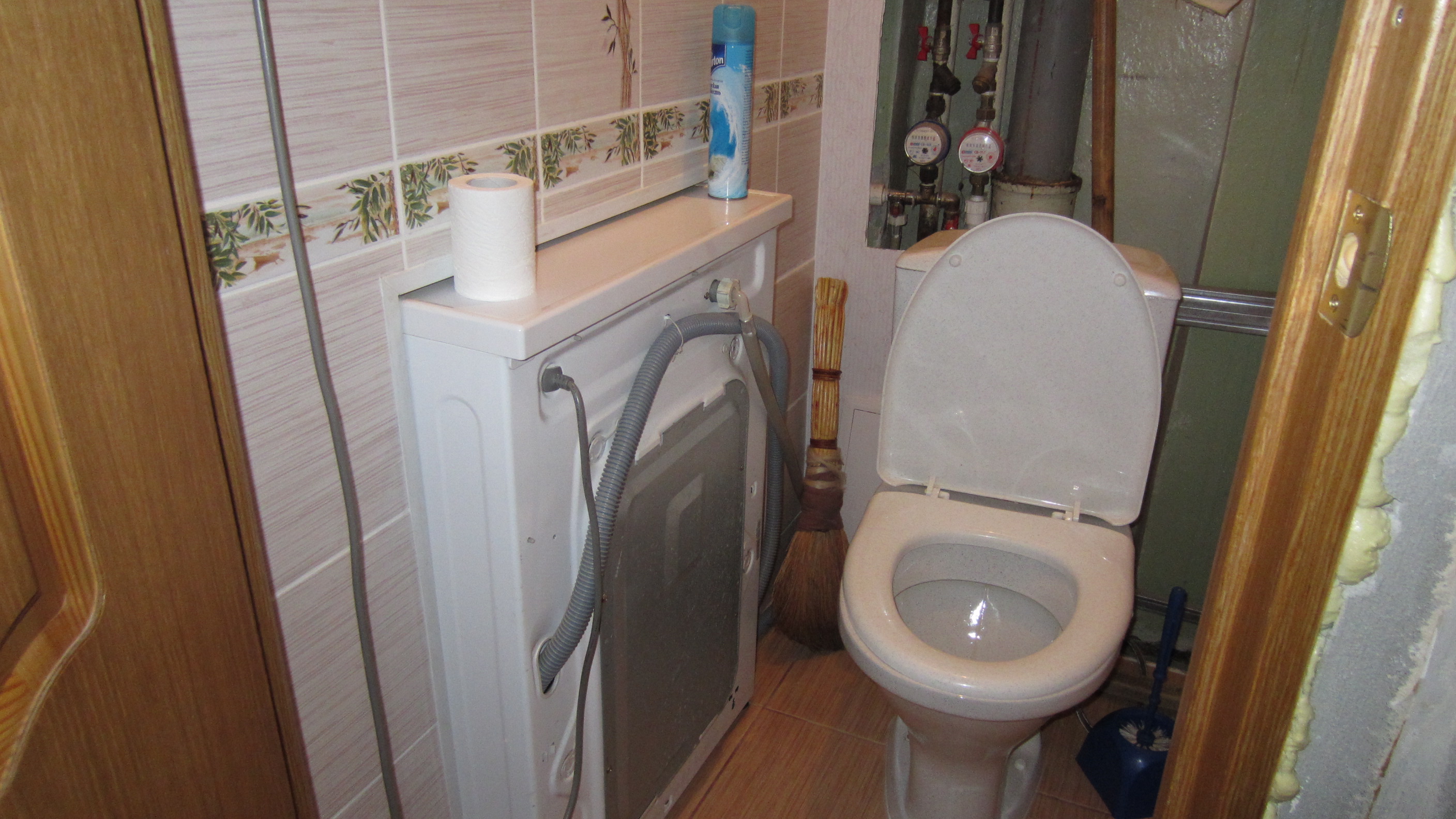
We spent that night with Yura’s friends from that church; there we saw some Russian ingenuity. The next morning, Sunday, Vladimir was asked to preach the sermon, and he gave a sermon on self-denial that was warmly received. We then drove north to Murmansk. Continue reading
Russian Ingenuity
What do you do if your washing machine is too big for the space you have? Well, you can do what a friend did:

 Mike and Olga Cantrell