We visited Tallinn a little while ago. Here are a few pictures from the old town, the well preserved medieval city that was a member of the Hanseatic League. Tallinn was earlier known as Reval.
I’m learning how to make these simple slideshow videos. This is my first attempt.
We believe that the Lord sets us together as members of His body, as living stones. As we honor the relationships that He establishes, then the work naturally flows. We made a video to help people see and understand better what MIR is and work to which we’ve been called.
Many thanks go to Thomas Umstattd for making this video. He came to Russia and lived with us for a month, helping in many ways.
A friend from the States was visiting for the past month. Thomas Umstattd came to Russia to help us set up computers in the MIR office, establish encrypted communications with partners in Belarus (very important), and he also made a short video for MIR which I’ll post here as soon as it’s ready to go. Several of us had dinner and then were on the Neva river embankment a few nights ago. I took this short video; the quality is bad but at least you can get a feel for how beautiful it is this time of year; and you can hear that Olga was enjoying herself —
Here’s a view of the Palace Bridge opening, at 1:30 in the morning during the white nights. I didn’t take this video, but I think it’s nice —
This is some cctv footage of an intersection we have driven through many times. You can see why it’s important to drive defensively in Russia.
These accidents are caused by people running or jumping a red light; both problems are common here. There are traffic lights at that intersection, but the size of the intersection means there are more collisions.
We went to dacha a few days ago. Olga’s grandfather Orest is not feeling well, and we brought him to the city to go into the hospital. He’s 90 years old and though his health is failing, his mind is still sharp.
I took this video of a classic dacha moment. Orest is building a fire while Olga and her grandmother Ludmilla are in the living room talking. It’s cold and snowy outside and warm with family inside.
Orest jokingly says, ‘this is the best technology’, and later, ‘I think, if you show this in America they will just fall over’. I like his sense of humor.
Orest has a very un-Russian name. His first name is from the Greek Orestes (meaning mountain-dweller); Groten is a Dutch/German surname.
His grandfather Nestor Maximilianovich Groten was a wealthy Russian landowner who was a railroad engineer and manager in Canada at the time of the Russian Revolution and did not return to Russia because of the danger to wealthy people like himself.
Orest’s father, Maximilian, was an ardent Communist who remained in Russia. When Orest was a child, he and his mother were in White territory during the Russian civil war (between the Reds and the Whites), and they were in danger because his father was a Red.
Orest fought in the Red Army in the Great Patriotic War (WWII) as a radio operator near the black sea. He later joined the Communist Party and was a naval engineer.
Orest lived through the Soviet period. Born in 1918, he saw the lifespan of Stalinism, lived through the times of Kruschev and Brezhnev; he witnessed the collapse of the USSR, the chaos of the 90s and the rise of Putin. And he saw the day when an American (!) would marry his granddaughter.
Just after I married Olga, Orest said to me, ‘fifteen years ago, if they [Communist leaders] knew I was talking to you, they would have shot me’. He witnessed dramatic changes in the culture.
Orest had to hide his family heritage because his name was not ‘truly Russian’ (and therefore suspect) and the Communists would persecute those with wealthy ancestors. This meant that Olga never heard family stories of her grandparents and great-grandparents.
Only recently have we begun to learn about those earlier generations. This is one legacy of the soviet doctrine — many Russian families now have broken links to past generations and much personal history has been lost. Orest’s life embodies much of the Russian experience over the past century.
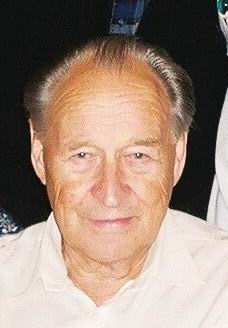
 Mike and Olga Cantrell